Buckley’s issue isn’t with boxing as a sport. It’s with what he believes modern boxing has become. In his view, elite boxers often prioritize defense and preserving undefeated records over pursuing knockouts. The result? High-level technical performances that may win rounds but don’t always win over fans.
The implication was clear: fighters like Stevenson, known for defensive mastery and ring IQ, represent excellence but not always excitement. Buckley’s message was blunt. If you’re a true fighter, you seek the finish. In MMA, coasting isn’t an option. One mistake can lead to a knockout, submission, or scramble that flips a fight instantly. The danger is constant. And in Buckley’s mind, that makes the UFC product more compelling.
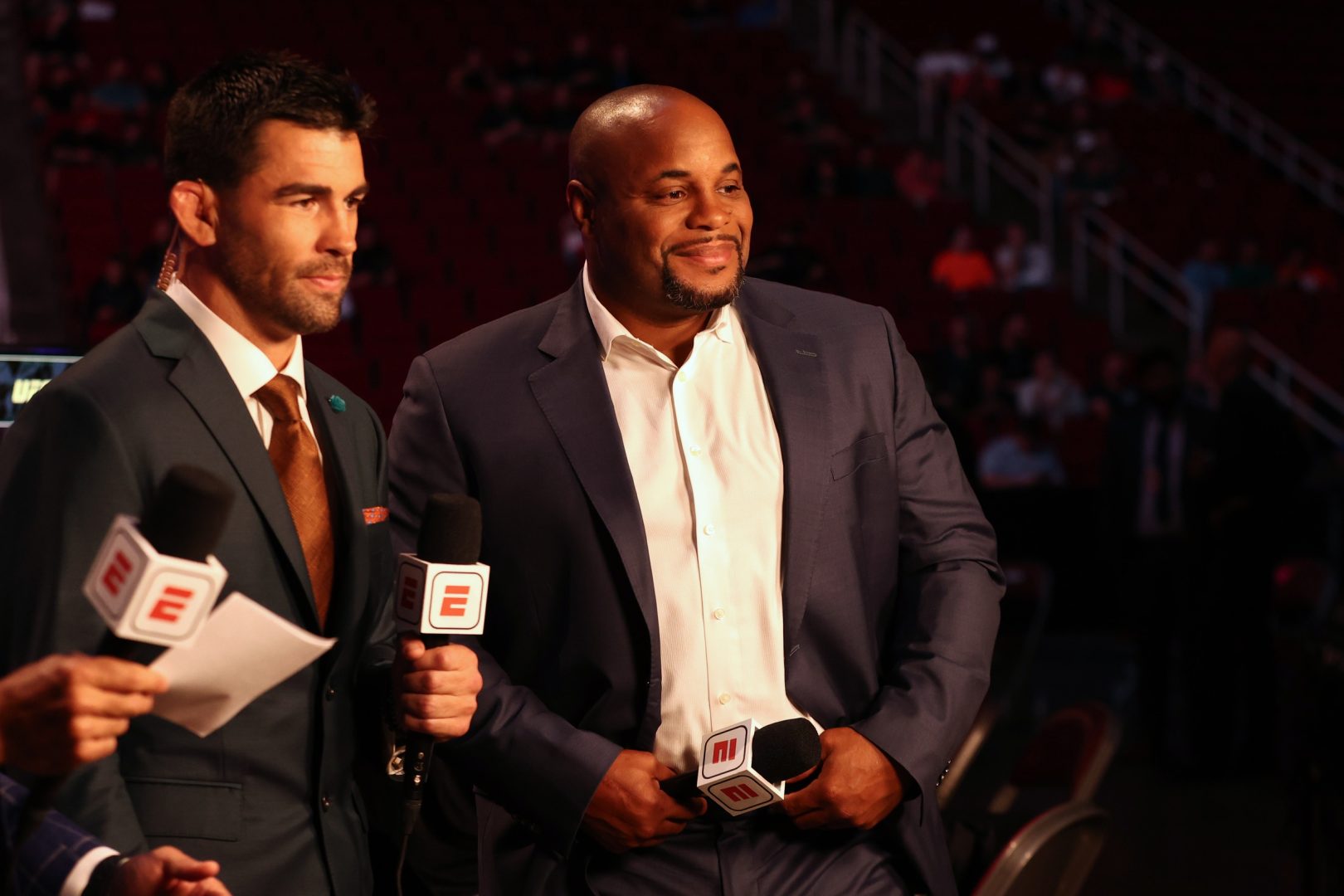
Cormier echoed Buckley’s sentiment but framed it historically. On his YouTube channel, Cormier said the UFC doesn’t need to be boxing especially not modern boxing.
“If I wanted to be boxing,” Cormier explained, “I’d want to be boxing of the ‘70s, ‘80s and ‘90s.” He referenced eras defined by icons like Muhammad Ali and Mike Tyson periods when heavyweight title fights felt like global events. He pointed to the days of Lennox Lewis and even the dominance of the Klitschko brothers, when championship bouts carried undeniable mainstream weight.
Cormier’s central argument: boxing once delivered massive stars fighting each other at the right time. Today, he believes, those consistent mega-clashes are harder to find.
The Canelo-Crawford Example
Cormier pointed to the recent mega-event between Canelo Alvarez and Terence Crawford at Allegiant Stadium as a prime example. On paper, it had everything: pound-for-pound royalty, star power, a Las Vegas stadium setting. It felt like a throwback spectacle.
But inside the ropes? Crawford delivered a masterful, controlled performance neutralizing Canelo with precision rather than fireworks. Cormier didn’t question the skill. He questioned the entertainment value. “Impressive,” he essentially argued, “doesn’t always mean fun.”
UFC’s Structural Advantage
Behind the verbal sparring lies a broader truth: the UFC’s centralized promotional model creates consistent matchmaking clarity. One promotion. One champion per division. Fewer political roadblocks. Boxing, meanwhile, continues to navigate multiple sanctioning bodies, promotional divides, and network politics — obstacles that can delay or derail superfights.
Cormier believes that’s part of why UFC championship bouts often feel more urgent. For Buckley, it’s simpler: the UFC’s best fight the best more frequently — and they do so in a rule set that encourages chaos.
Respect, But a Reality Check
Cormier was careful to note his love for boxing. He’s close friends with former champion Andre Ward and remains a student of the sport. But admiration doesn’t mean silence. From his perspective, the UFC today consistently produces more action-heavy, emotionally charged main events than modern boxing’s biggest showcases.
That doesn’t diminish Stevenson’s brilliance or Crawford’s mastery. It simply reframes the question. Is technical perfection enough? Or does unpredictability define today’s combat sports fan?
The Verdict in 2026
In a city like Las Vegas where boxing history and UFC dominance now share the same marquee lights the debate carries extra weight. Boxing still owns the tradition. The UFC may own the momentum. And as long as fighters like Stevenson defend the sweet science while athletes like Buckley challenge it, the conversation won’t fade anytime soon. For now, Buckley believes the UFC doesn’t need to be boxing. Cormier believes it’s already something better.